
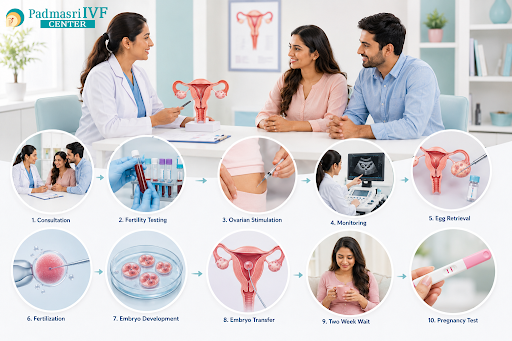
One of the most common questions couples ask when considering fertility treatment is, "How long does IVF treatment actually take?" It is a natural concern because IVF is an important emotional, physical, and financial commitment. Understanding the timeline helps couples prepare mentally, plan their schedules, and approach treatment with realistic expectations.
The answer is not always the same for everyone. IVF timelines can vary depending on age, fertility condition, medical history, ovarian response, and the treatment plan designed for each patient. While some couples may complete a cycle within a few weeks, others may require additional preparation or specialized procedures before treatment begins.
At padmasrihospitalsandivfcentre, we believe that informed patients feel more confident throughout their fertility journey. Understanding each step of IVF can reduce anxiety and help couples stay focused on their ultimate goal of achieving a healthy pregnancy. As the Best IVF centre in Andhra Pradesh, we guide couples through every stage with personalized care and advanced reproductive technology.
Before discussing how long IVF takes, it is important to understand what IVF actually involves. IVF, or In Vitro Fertilization, is an advanced fertility treatment in which eggs are retrieved from the ovaries and fertilized with sperm in a specialized laboratory. The resulting embryos are then monitored and one or more healthy embryos are transferred into the uterus.
Unlike natural conception, IVF allows fertility specialists to carefully monitor and support every critical stage of fertilization and embryo development. This significantly improves the chances of pregnancy for many couples facing fertility challenges.
The IVF process consists of several carefully planned phases, each requiring specific timing and medical supervision. Understanding these phases helps explain why IVF treatment cannot be rushed and why patience is essential throughout the process.
IVF has become one of the most successful fertility treatments available today. Couples choose IVF for many different reasons, and the treatment is often recommended when other fertility methods have not been successful.
Because every fertility journey is unique, the timeline for IVF treatment can vary based on the specific challenges being addressed.
When discussing IVF timelines, most people are referring to a complete IVF cycle. In general, a standard IVF cycle takes approximately four to eight weeks from the beginning of ovarian stimulation to pregnancy testing.
However, when preparation, fertility evaluations, consultations, and additional treatments are included, the entire process may extend over several months.
At the Best IVF centre in Andhra Pradesh, every stage is carefully scheduled to maximize success while ensuring patient comfort and safety.
The first step in any IVF journey is a detailed consultation. During this appointment, fertility specialists review the couple's medical history, reproductive history, previous treatments, and lifestyle factors that may influence fertility.
This consultation serves as the foundation for the entire treatment plan. It helps identify potential obstacles and ensures that the most effective approach is selected.
During the evaluation, we spend time understanding the patient's fertility goals, previous pregnancy history, menstrual patterns, and any existing medical conditions that may affect treatment outcomes.
Many couples feel relieved after this consultation because they finally gain clarity regarding their fertility challenges and available treatment options.
Before IVF begins, comprehensive fertility testing is performed to assess reproductive health and identify factors that may affect treatment success.
Diagnostic testing provides valuable information about ovarian reserve, sperm quality, uterine health, and hormone levels. These results help fertility specialists create a customized treatment protocol.
At padmasrihospitalsandivfcentre, we use detailed fertility assessments to ensure every treatment plan is tailored specifically to the patient's needs.
Once all fertility test results are available, specialists create a personalized IVF protocol. This stage is extremely important because no two fertility journeys are exactly alike.
Treatment plans are customized based on:
This individualized approach helps improve treatment efficiency and increases the likelihood of successful outcomes.
As the Best IVF centre in Andhra Pradesh, we focus on personalized fertility care rather than using a one-size-fits-all approach.
Ovarian stimulation is one of the most important stages of IVF treatment. During a natural menstrual cycle, a woman typically produces one mature egg. In IVF, fertility medications are used to encourage the ovaries to produce multiple mature eggs.
Producing multiple eggs increases the chances of obtaining healthy embryos for transfer.
Patients receive carefully monitored fertility injections according to their customized treatment plan.
During this period, patients continue normal activities while attending scheduled monitoring appointments.
Monitoring is a critical component of IVF treatment. Specialists carefully track follicle growth and hormone levels to determine how the ovaries are responding to medication.
Regular monitoring allows dosage adjustments when necessary and helps identify the ideal time for egg retrieval.
The purpose of monitoring is not simply to observe growth but to optimize treatment outcomes by ensuring that eggs mature appropriately before retrieval.
This stage requires patience because every woman's ovaries respond differently. Some patients respond quickly, while others require additional days of stimulation.
At the Best IVF centre in Andhra Pradesh, advanced monitoring protocols help us make informed treatment decisions that support successful IVF outcomes.
Not every patient follows exactly the same timeline. Several factors influence how quickly follicles mature and become ready for retrieval.
Because every fertility journey is unique, flexibility in timing is often necessary to achieve the best possible results.
While much attention is given to the medical aspects of IVF, emotional preparation is equally important. The first few weeks of treatment often bring excitement, hope, anxiety, and anticipation.
Couples benefit from maintaining realistic expectations and understanding that IVF is a step-by-step process. Success does not depend on speed but on careful planning and personalized care.
We encourage patients to:
At padmasrihospitalsandivfcentre, we believe emotional support plays an essential role in creating a positive fertility treatment experience.
Once the fertility specialist determines that the follicles have reached the appropriate size, a trigger injection is administered. This medication plays a crucial role in the IVF process because it helps the eggs reach their final stage of maturation before retrieval.
The timing of the trigger injection is extremely important. Administering it too early or too late can affect egg quality and retrieval success. This is why fertility specialists carefully monitor follicle development throughout the stimulation phase.
The trigger injection marks an important milestone because it signals that egg retrieval is approaching.
Egg retrieval is a minimally invasive procedure performed under sedation. During the procedure, a specialized needle guided by ultrasound is used to collect mature eggs from the ovaries.
Most patients are surprised by how quick the procedure actually is. While the retrieval itself takes approximately 20 to 30 minutes, patients usually remain under observation for a few hours afterward.
Many patients return home on the same day and resume light activities within 24 hours.
At padmasrihospitalsandivfcentre, patient comfort and safety remain priorities throughout the egg retrieval process.
After egg retrieval, embryologists examine the eggs and identify mature eggs suitable for fertilization. The collected sperm sample is also processed and prepared.
Fertilization occurs in a highly controlled laboratory environment designed to mimic natural conditions as closely as possible.
The fertilized eggs are then observed carefully to determine which have successfully developed into embryos.
This stage represents one of the most exciting moments in the IVF journey because it marks the beginning of embryo development.
After fertilization, embryos are monitored continuously by experienced embryologists. During this period, specialists evaluate embryo growth, cell division, and developmental quality.
Not every fertilized egg develops into a viable embryo. Therefore, close observation is essential to identify the strongest embryos for transfer.
Many fertility centers prefer transferring embryos at the blastocyst stage because they have demonstrated stronger developmental potential.
As the Best IVF centre in Andhra Pradesh, we utilize advanced embryo culture techniques that support healthy embryo development and selection.
Embryo transfer is one of the most anticipated steps of the IVF journey. During this procedure, selected embryos are carefully placed into the uterus using a thin catheter.
Unlike egg retrieval, embryo transfer generally does not require anesthesia and is usually painless.
The procedure itself is quick, but emotionally it often represents a major milestone for couples who have been waiting to reach this stage.
After embryo transfer, patients enter what is commonly called the "two-week wait." This period can feel longer than any other stage because couples eagerly await pregnancy results.
During this time, the embryo attempts to implant within the uterine lining. Although patients may notice symptoms, symptoms alone cannot reliably predict pregnancy.
Patience is especially important during this stage because implantation occurs naturally and cannot be accelerated.
A blood test is performed to measure human chorionic gonadotropin (hCG), the hormone produced during pregnancy.
This test provides accurate information regarding whether implantation has occurred successfully.
For many couples, this moment represents the culmination of weeks or months of preparation and treatment.
At the Best IVF centre in Andhra Pradesh, pregnancy testing is accompanied by detailed counseling and next-step guidance regardless of the outcome.
Although many IVF cycles proceed smoothly, certain circumstances may lengthen treatment duration.
These delays can be frustrating, but they are often necessary to maximize the chances of success.
The type of embryo transfer performed can influence the overall timeline.
In a fresh cycle, embryos are transferred shortly after development, usually within the same treatment cycle.
Embryos are frozen and transferred during a later menstrual cycle after the uterus has been optimally prepared.
In some situations, frozen embryo transfers may provide improved outcomes despite extending the overall treatment timeline.
Preparation can help improve both the IVF experience and treatment outcomes.
At padmasrihospitalsandivfcentre, we emphasize comprehensive fertility care that supports patients medically, emotionally, and physically.
Not necessarily. Many patients assume that longer treatment means better outcomes, but success depends more on treatment quality than treatment length.
Every IVF journey is unique. Some patients achieve success during their first cycle, while others may require multiple cycles. The focus should always be on creating the best possible conditions for pregnancy rather than completing treatment quickly.
Consulting the Best IVF centre in Andhra Pradesh ensures that treatment decisions are based on medical evidence and individual patient needs rather than fixed timelines.
IVF is not simply a procedure; it is a carefully planned fertility journey. Personalized treatment allows fertility specialists to adjust medications, monitor progress, and respond to individual needs throughout every stage.
At padmasrihospitalsandivfcentre, we understand that every patient has unique fertility challenges and goals. Our individualized approach helps optimize outcomes while providing the support couples need during treatment.
Patients seeking the Best IVF centre in Andhra Pradesh often look for personalized care, advanced laboratory technology, experienced fertility specialists, and transparent communication throughout the IVF process.
So, how long does IVF treatment take from start to finish? For most couples, an IVF cycle takes approximately four to eight weeks from ovarian stimulation through pregnancy testing. However, when consultations, diagnostic evaluations, treatment planning, and additional procedures are included, the complete fertility journey may extend over several months.
The IVF process includes multiple stages such as fertility evaluation, ovarian stimulation, follicular monitoring, trigger injection, egg retrieval, fertilization, embryo development, embryo transfer, and pregnancy testing. Each step serves a critical purpose and contributes to overall treatment success.
At padmasrihospitalsandivfcentre, we believe that understanding the IVF timeline helps patients feel more confident and prepared. As the Best IVF centre in Andhra Pradesh, our goal is to guide couples through every stage with expertise, compassion, and advanced reproductive care. While every journey is unique, the right support and personalized treatment plan can bring couples closer to achieving their dream of parenthood.
1. How long does one complete IVF cycle usually take?
A standard IVF cycle generally takes about four to eight weeks from ovarian stimulation to pregnancy testing. The total timeline may be longer when consultations, testing, and preparation are included.
2. Can IVF treatment be completed in one month?
Some IVF cycles can be completed within a month, especially when no additional testing or procedures are required. However, many couples need extra preparation before treatment begins.
3. Why does IVF take several weeks?
IVF involves multiple carefully timed stages including stimulation, monitoring, egg retrieval, fertilization, embryo development, and transfer. Each stage is necessary to maximize the chances of success.
4. Does age affect the IVF timeline?
Age does not always change the length of a cycle, but it can influence treatment planning and response to medications. Older patients may require additional monitoring or specialized approaches.
5. What is the longest part of the IVF process?
Many patients find the two-week wait after embryo transfer to be the longest stage emotionally. Although it lasts only 10 to 14 days, it can feel much longer due to anticipation.
6. Can IVF timelines vary between patients?
Yes, every fertility journey is unique. Medical history, ovarian response, fertility diagnosis, and treatment goals can all affect the overall timeline.
7. What happens if embryos are frozen?
When embryos are frozen, the transfer occurs during a future cycle. This extends the overall timeline but may provide advantages in selected situations.
8. How can I prepare for IVF treatment?
Following medical instructions, maintaining a healthy lifestyle, attending appointments, and staying emotionally supported can help create a smoother IVF experience and improve treatment outcomes.